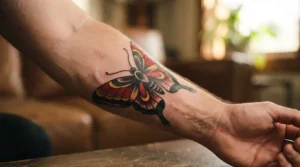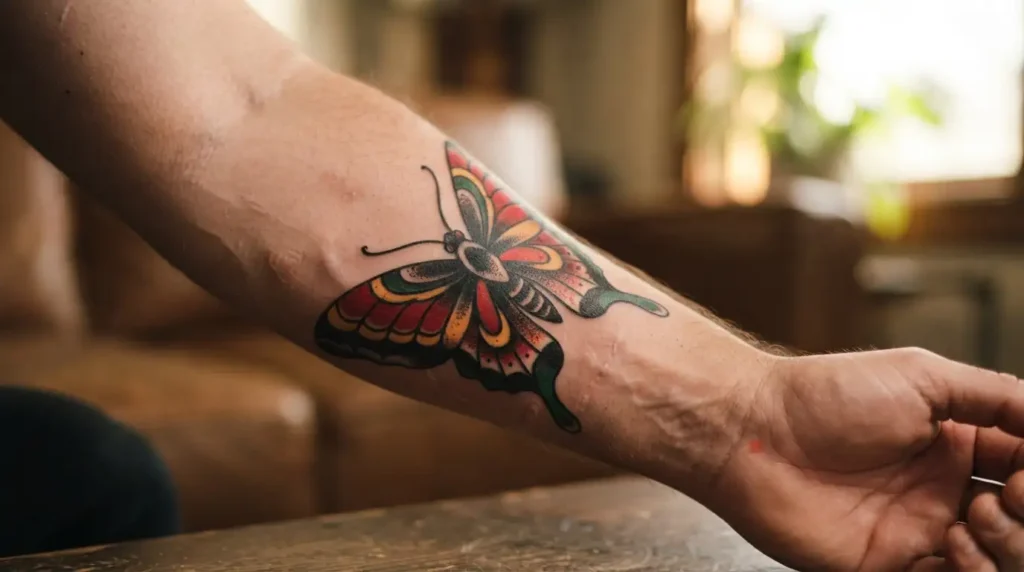
⚡ QUICK ANSWER: A traditional butterfly tattoo is an old-school American design built on bold black outlines, a limited color palette (red, yellow, green, brown), and flat 2D shading. Born from sailor tattoo tradition, it symbolizes transformation, safe return, and endurance — and it’s the most age-proof butterfly style in the entire industry.
A traditional butterfly tattoo is the anti-trend. While watercolor washes fade into debate and fine lines blur under inexperienced hands, the old-school butterfly stays crisp for decades — bold lines, flat color, zero ambiguity. It’s the style your grandfather’s shipmates wore, and it’s trending harder right now than it has in forty years.
This guide covers everything: the style DNA that makes traditional ink last a lifetime, the sailor history behind the meaning, 25 flash-worthy design ideas, honest placement and pain comparisons, and exactly what to say to your artist so you walk out with a piece that looks better in 2045 than it does today.
📌 KEY TAKEAWAYS
- Style DNA: bold black outlines, limited palette (red, yellow, green, brown), flat 2D shading
- Roots: sailor tattoo tradition — the butterfly joined swallows and anchors as a safe-return symbol
- Aging: the best of any style — traditional pieces from the 1940s still read crisp today
- Sweet spot: 3+ inches — bold work needs room to breathe
- Best placements: forearm, upper arm, shoulder, calf, chest
- Monarch-inspired traditional pieces connect naturally to the classic orange-and-black palette
What Is a Traditional Butterfly Tattoo? The Style DNA
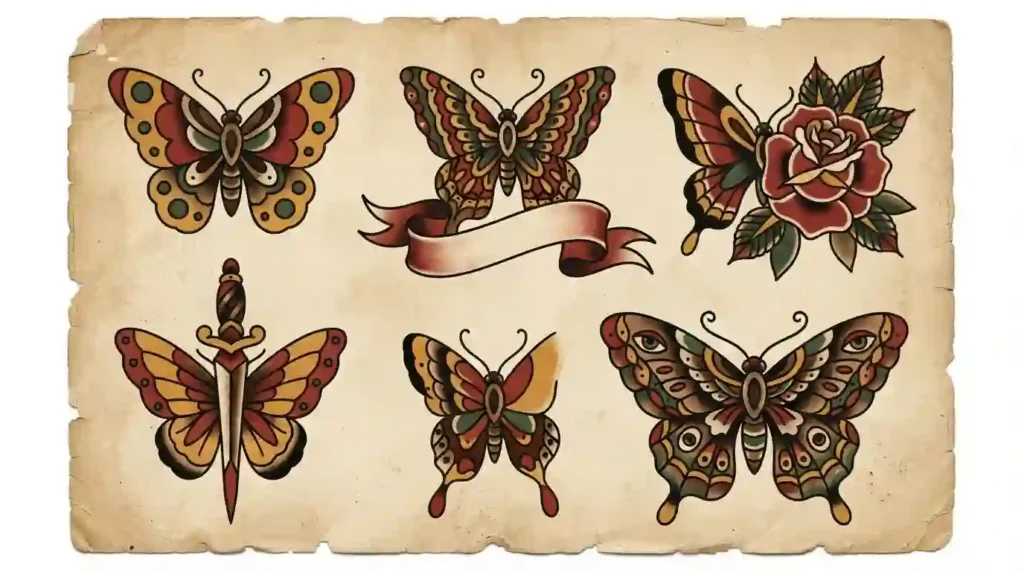
A traditional butterfly tattoo — sometimes called old-school or American traditional — follows design rules that were codified over a century ago and haven’t changed since. That rigidity is the point. Every element exists because it survives on skin:
| Element | The Rule | Why It Lasts |
|---|---|---|
| Outlines | Thick, confident black lines | Bold ink blurs slowest — the outline holds the shape for decades |
| Palette | Red, yellow, green, brown — rarely more | Saturated mid-tones age far better than pastels or white |
| Shading | Flat 2D color zones with whip-shaded edges | No soft gradients to wash out over time |
| Detail level | Simplified, readable from across the street | No tiny details to merge and muddy |
| Composition | Centered, symmetrical, iconic | Reads instantly at any size, any angle |
The history runs deep. Tattooing itself dates back thousands of years — Britannica traces the practice across ancient cultures worldwide — but American traditional as we know it crystallized in the late 1800s and early 1900s, carried port to port by sailors. Artists like Norman “Sailor Jerry” Collins refined the flash style into what studios still hang on their walls today, as Smithsonian Magazine has covered in its pieces on tattoo history [verify exact article].
Compare that DNA with modern styles and the difference is stark: watercolor’s soft washes are gorgeous but demand touch-ups, and fine line’s whisper-thin strokes depend entirely on artist skill. The traditional butterfly trades delicacy for permanence — and for a lot of people, that trade is exactly right. If you’re weighing styles, our guide to watercolor butterfly tattoo designs shows the opposite end of the spectrum.
Traditional Butterfly Tattoo Meaning: From Sailor Ink to Today
The traditional butterfly tattoo meaning stacks three layers — the sailor code, the butterfly’s universal symbolism, and the style’s own attitude.
The Sailor Layer: Safe Return
Sailors wore butterflies alongside swallows and anchors as talismans for long voyages — symbols of safe return and transformation across the water. A butterfly emerging from a chrysalis mirrored the journey itself: leave as one thing, come back as another. When you choose this style, you’re wearing a code that generations of travelers lived by.
The Symbol Layer: Transformation and Endurance
Butterflies have meant transformation, freedom, and rebirth across cultures for centuries — the full history is in our guide to butterfly tattoo meanings and symbolism. But there’s a second meaning hiding in the style choice itself: choosing the most durable tattoo tradition on earth to express your transformation says something about endurance. You didn’t just change — you changed for good.
The Monarch Connection
The classic traditional butterfly — orange, black-edged, bold — is almost always monarch-inspired, whether the artist says so or not. The monarch’s 3,000-mile one-way migration makes it the ultimate endurance symbol, and its natural palette happens to match the traditional tattoo palette perfectly. Our monarch butterfly tattoo meaning guide covers the journey — and the cultural connections worth knowing before you borrow them.
25 Traditional Butterfly Tattoo Designs Worth Bringing to Your Artist
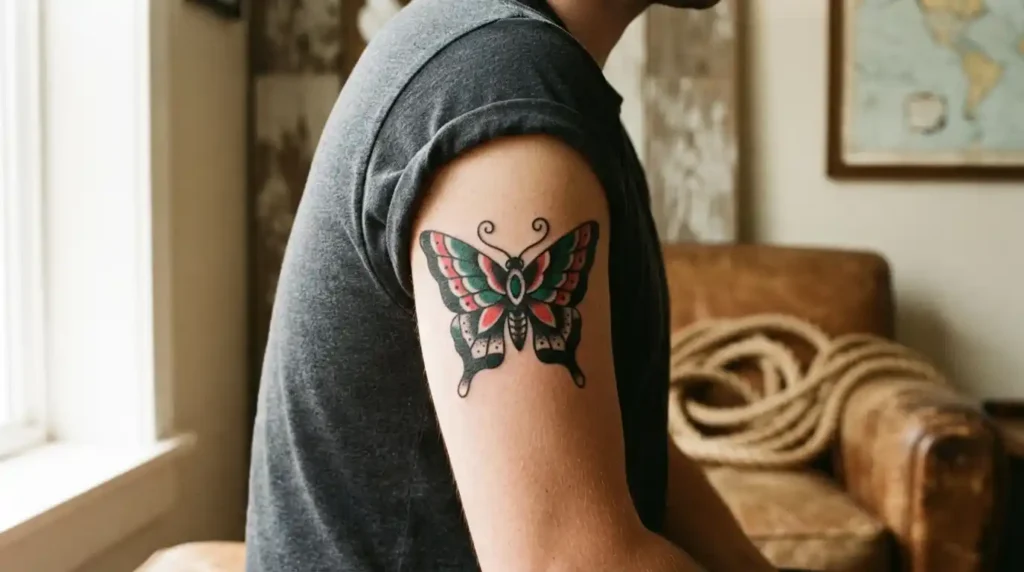
Every idea below follows flash logic — simplified, bold, built to last. Screenshot your direction, then let your artist redraw it properly for your placement.
Classic Flash Butterflies (1–6)
- Thee classic: symmetrical butterfly, bold outline, red-and-yellow wings, green accents
- Single butterfly with whip-shaded brown wing bases
- Black-and-brown traditional butterfly — the “work-wear” version, no color at all
- Butterfly with dotted wing borders, old-school flash style
- Double butterfly pair, mirror-imaged, sized for both shoulders
- Chunky shoulder-cap butterfly with heavy black shading
With Banners, Script & Symbols (7–12)
- Butterfly over a classic scroll banner — a date, a name, or “homeward”
- Butterfly paired with an old-school swallow in flight
- Butterfly and anchor combo — the full sailor set
- Butterfly with a horseshoe and three stars for luck
- Butterfly above a classic heart with a banner
- Butterfly circling a traditional nautical star
Classic Combos (13–18)
- Butterfly and rose — the most-requested traditional pairing
- Butterfly with a dagger, old flash style
- Butterfly landing on a traditional snake — transformation and rebirth doubled
- Butterfly with a lantern — guidance through the dark
- Butterfly and moth pair — day and night on one arm
- Butterfly escaping a traditional spiderweb
Modern Twists (19–25)
- Neo-traditional butterfly — same bold lines, expanded jewel-tone palette
- Traditional butterfly with decorative filigree wings
- Half butterfly, half rose — one stem, one design
- Micro traditional butterfly, 2 inches, simplified to its boldest lines
- Traditional butterfly in a moon-and-stars frame
- Blackwork butterfly with traditional layout — modern ink, old bones
- Matching traditional butterflies for two people — one bold, one simplified
Traditional vs. Every Other Butterfly Style
Here’s how the old-school butterfly stacks up against the styles your Pinterest board is full of:
| Style | Look | Aging | Best For |
|---|---|---|---|
| Traditional | Bold, flat, iconic | The best — stays crisp for decades | Lifers, first-timers who want zero maintenance regret |
| Fine line | Delicate, thin, quiet | Good — depends heavily on artist skill | Minimalists, hidden ink |
| Watercolor | Painted washes, dreamy | Needs touch-ups sooner | Romantics, color lovers |
| Realistic / 3D | Photo-level depth | Strong at large sizes | Statement pieces |
| Neo-traditional | Traditional bones, richer color | Excellent | The style bridge between old and new |
The full seven-style breakdown — with costs and placement fit for each — is in our complete butterfly tattoo guide.
Best Placements for a Traditional Butterfly Tattoo
Traditional designs read best at 3 inches or larger — bold work squeezed into a tiny space loses the entire point. The honest placement map:
| Placement | Typical Pain | Best Size | Why It Works |
|---|---|---|---|
| Forearm | Low–Moderate | 3–5 in | Classic flash territory, daily visibility |
| Upper arm / bicep | Low–Moderate | 3–6 in | The historical sailor placement |
| Shoulder | Moderate | 4–6 in | Curved canvas suits spread wings |
| Calf | Moderate | 3–5 in | Room for combos, easy to conceal |
| Chest | Moderate–High | 5–8 in | Maximum presence, full flash energy |
| Thigh | Low–Moderate | 4–6 in | Big canvas, low pain, rarely sun-exposed |
Pain is personal — these reflect common descriptions, not guarantees. For every body zone compared side by side, see our guide to butterfly tattoo ideas and placements. And if a bold butterfly has you thinking bigger, our guide to the butterfly tattoo ideas men wear leans heavily traditional — the style is a cornerstone of masculine ink.
What to Tell Your Artist
Traditional is a specialization — not every artist does it well. Search for artists who advertise “American traditional” or “old school” specifically, then ask to see healed pieces at least five years old. That’s the entire test: a good traditional tattoo looks almost identical at year five as it did on day one.
Then say the magic words: “bold will hold.” It’s a saying in the traditional community for a reason — if an artist suggests thinning your outlines to make the design “prettier,” find a different artist. The outline is the design.
FAQ About Traditional Butterfly Tattoos
What does a traditional butterfly tattoo mean?
Transformation, safe return, and endurance. The meaning comes from three layers: sailor tradition (butterflies as safe-return talismans on long voyages), the butterfly’s universal symbolism of rebirth, and the style’s own message of permanence — a change that lasted. Many people also connect the classic orange-and-black design to the monarch’s famous migration.
Do traditional tattoos age better than other styles?
Yes — decisively. Bold black outlines, saturated mid-tone colors, and flat shading are the most durable elements in tattooing, which is why traditional pieces from the 1940s still read clearly today. Fine lines and soft washes age faster by comparison. If “I never want a touch-up” is your priority, traditional wins.
How much does a traditional butterfly tattoo cost?
Most shops’ minimums ($50–$100) cover a small simple piece. A 3–4 inch traditional butterfly with full color typically runs $150–$350, and larger combo pieces with banners or florals run higher. Traditional is often faster to tattoo than realism, which can keep the price friendlier — but rates vary by city and artist, so get a direct quote.
What colors are used in a traditional butterfly tattoo?
The classic palette is red, yellow, green, and brown with heavy black outlines — the exact saturated mid-tones that age best in skin. Some modern artists expand into blues and purples (that’s neo-traditional), which still holds well. Pastels and white highlights are the only colors traditional avoids — they’re the first to fade.
Can a traditional butterfly tattoo be small?
Yes, but there’s a floor: around 2 inches. Below that, the bold outlines crowd together and the design loses its readability — the whole appeal of traditional is instant recognition. At 2–3 inches simplified, it still works beautifully; at fingernail scale, choose a fine line design instead.
Is a traditional butterfly tattoo feminine or masculine?
Both — that’s the style’s superpower. The same design rules produced sailor chest pieces and pin-up era arm candy alike. Style it with daggers, snakes, or anchors and it reads rugged; pair it with roses and banners and it reads romantic. The boldness is neutral. The story is yours.
Final Thoughts
A traditional butterfly tattoo is the rare design that gets more attractive the longer you own it. Bold lines don’t blur, saturated color doesn’t vanish, and the style’s century of history means your ink connects to something bigger than a trend. Choose 3 inches or more, find an artist who lives in the old-school tradition, and remember the saying that built the style: bold will hold.
Compare it against every other look in the complete butterfly tattoo guide, give it a story with our butterfly tattoo meanings and symbolism guide, and explore butterfly tattoo ideas and placements to pick its home on your body. A traditional butterfly tattoo isn’t just ink — it’s a membership in the oldest running club in tattooing.