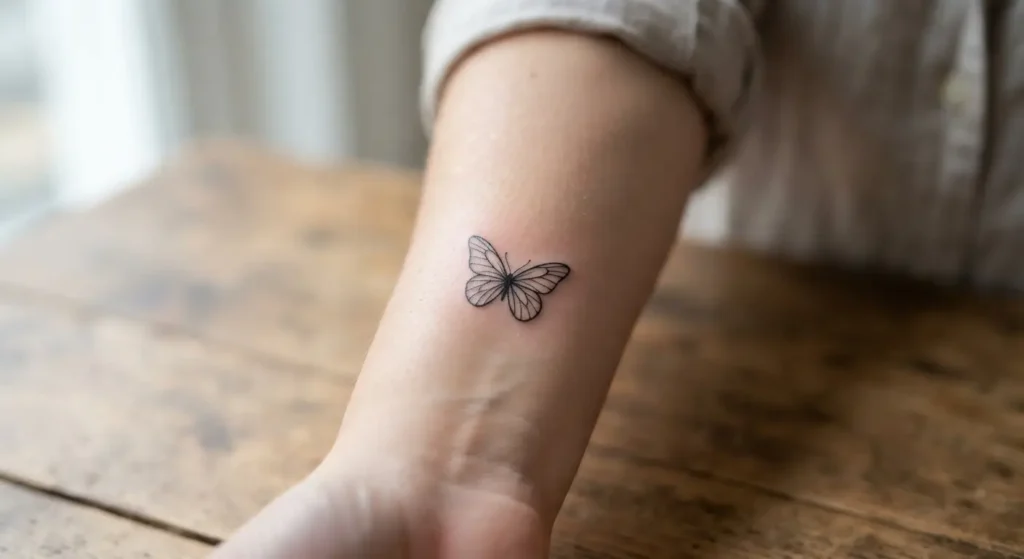
You’ve probably sketched a butterfly on a napkin at least once, thinking about where you’d put it and whether you’d still love it in ten years. That’s the real question behind every simple butterfly tattoo: not “is it cute,” but “will it hold up.”
This guide walks through 20 clean, minimalist butterfly designs that stay sharp as they age, plus where to place them, what they typically cost in pain, and how to talk to your artist so the line work doesn’t blur into a smudge by year five.
Key Takeaways
- A simple butterfly tattoo relies on bold, even linework rather than fine detail, which is what keeps it crisp over time.
- Size matters more than most people expect — under 1.5 inches, delicate lines tend to blur as skin ages.
- Forearm, wrist, ankle, and shoulder blade are the most forgiving placements for a first tattoo.
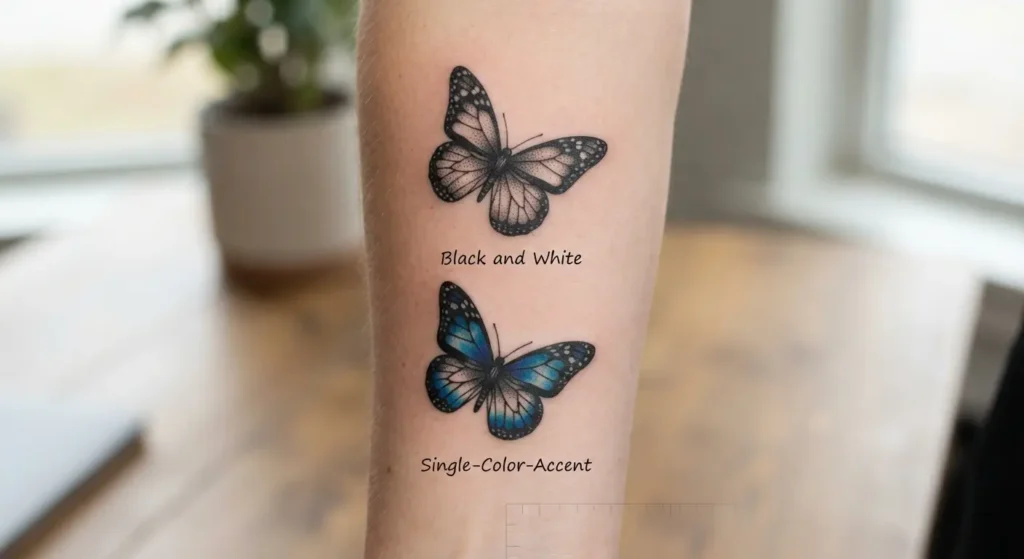
- Black and white designs age more predictably than color, though a single accent color can still work.
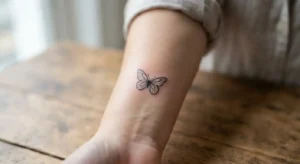
- Your artist’s opinion on line weight matters as much as your reference photo — ask before you book.
Why a Simple Butterfly Tattoo Works So Well
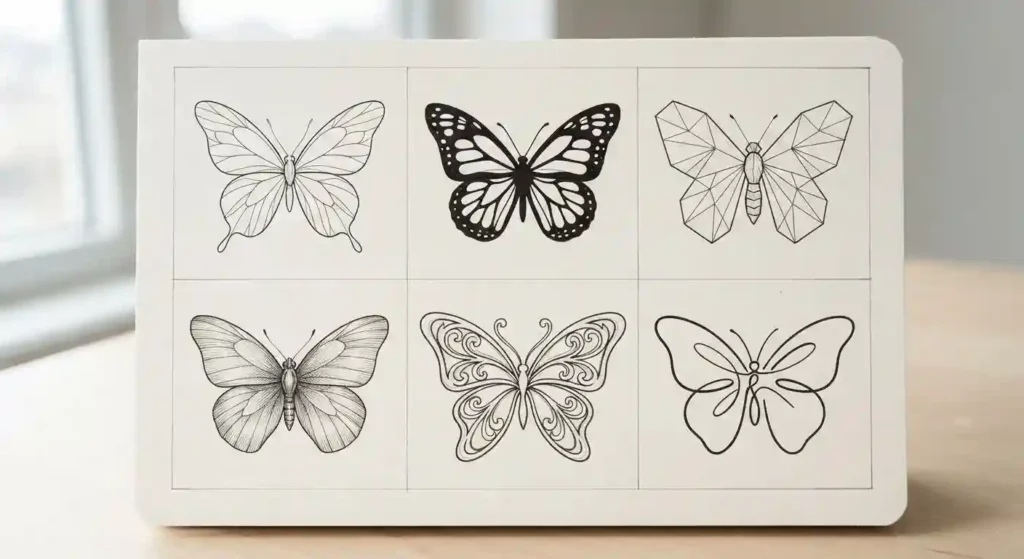
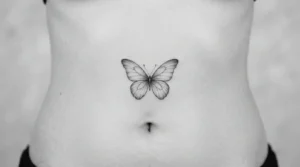
A butterfly is already a simple shape: two symmetrical wings, a body, and antennae. That symmetry is part of why it reads clearly even in a minimalist butterfly tattoo with almost no shading. The design does the work; you don’t need extra detail to make it recognizable.
The tradeoff is that “simple” isn’t the same as “easy to get wrong.” Thin lines packed too close together are the most common reason a small tattoo fades into a blur. Ask your artist to keep line spacing loose enough that the design won’t merge as ink settles.
20 Simple Butterfly Tattoo Ideas
Here are 20 directions to bring to your consultation, grouped by the choice they’re built around.
Line style
- Single continuous outline, no shading
- Fine-line wings with one bold black body
- Dotwork wingtips with a solid outline
- Geometric wings built from straight lines and triangles
- Hand-poke style for a softer, slightly irregular line
Size and placement
6. Tiny 1-inch butterfly behind the ear
7. 2-inch wrist butterfly, wings angled to follow the wrist bone
8. 3-inch ankle butterfly, wings flat against the skin
9. Matching pair, one on each collarbone
10. Trail of three shrinking butterflies along the spine
Color choice
11. Solid black silhouette
12. Black outline with negative-space (unshaded) wings
13. Black and white butterfly tattoo with light gray shading for depth
14. Single color accent, like one blue wing tip
15. Outline in black with a thin gold line detail
Symbolic variations
16. Monarch-inspired wing pattern — read more in our monarch butterfly tattoo meaning guide if the transformation symbolism matters to you
17. Moth-butterfly hybrid for a slightly edgier take
18. Butterfly mid-flight, wings angled as if caught in motion
19. Butterfly resting with wings closed, a quieter, less literal shape
20. Butterfly formed from a single flowing line that becomes a flower stem
If you want a full breakdown of what each version can represent, our guide to butterfly tattoo meanings and symbolism covers transformation, freedom, and rebirth in more depth.
Placement, Pain, and Size: What to Actually Expect
Placement decides two things at once: how much it hurts, and how well the tattoo will age. Thin skin over bone hurts more and can also distort fine linework over time.
| Placement | Pain Level | Best For |
|---|---|---|
| Outer forearm | Low | First tattoos, larger simple designs |
| Ankle | Moderate | Small, single-line butterflies |
| Wrist | Moderate–High | Small designs, minimal shading |
| Behind the ear | Moderate–High | Tiny, 1-inch designs only |
| Shoulder blade | Low–Moderate | Medium designs, 3+ inches |
| Ribs | High | Larger, more detailed pieces |
| Spine | High | Vertical, trailing designs |
Pain is subjective and varies by person, but as a general rule, areas with more nerve endings and less padding — ribs, spine, wrist, ankle — hurt more than fleshier spots like the outer forearm or shoulder. Healthline has a detailed breakdown by body area if you want to compare before your appointment.
On sizing: a simple butterfly tattoo generally looks best between 2 and 3 inches wide. Go smaller than that and fine lines are more likely to blur as your skin changes over the years; go much larger and a “simple” design can start to look sparse without some added detail.
For more placement ideas beyond what’s listed here, our butterfly tattoo ideas and placements guide covers larger and more detailed options too.
Style Variations to Discuss With Your Artist
- Fine line: delicate, single-needle lines. Best on flatter, less bendy areas like the forearm or shoulder blade.
- Solid black: a bold silhouette with no interior detail. The most durable option for tiny placements.
- Minimalist line art with negative space: outline only, using your skin tone as the “fill.” Reads as more modern but shows aging (stretch marks, sun spots) more visibly over time.
Bring 2–3 reference images rather than one. It gives your artist room to adjust line weight and spacing for your specific skin and placement instead of copying a photo that may not translate well to your body.
Aftercare Basics for a Small Tattoo
Small, simple tattoos heal the same way any tattoo does — they just show flaws in the linework faster if aftercare is rushed. The American Academy of Dermatology recommends keeping tattooed skin clean and moisturized with a fragrance-free, water-based lotion, and protecting healed tattoos from direct sun with SPF once they’re fully closed. Skip petroleum-based products, since they can pull pigment and fade the design faster.
Always follow your specific artist’s aftercare sheet over general advice — they know their own ink and technique best.
FAQ
Is a simple butterfly tattoo a good first tattoo?
Yes. The design is quick to tattoo, relatively low-commitment in size, and works on forgiving placements like the forearm or shoulder blade. It’s one of the more common “first tattoo” choices for that reason.
How much does a simple butterfly tattoo cost?
Cost varies widely by studio, city, and artist experience [STAT: verify with local pricing]. A small, single-color design is usually priced at or near a shop’s minimum rate.
Does a small butterfly tattoo fade faster than a large one?
Fine details can blur sooner on very small tattoos as skin ages, but a well-spaced, appropriately sized design (2–3 inches) with solid black linework holds up about as well as any other simple tattoo.
Where is the least painful place to get a butterfly tattoo?
The outer forearm and shoulder blade are generally the least painful spots, since they have more muscle and fat padding and fewer nerve endings than areas like the wrist or ribs.
Can I add color to a simple butterfly tattoo later?
Often, yes — a black outline can usually take color later without a full redo. Ask your artist during the first session so they leave enough space in the linework for it.
Final Thoughts
A simple butterfly tattoo earns its popularity honestly: it’s readable at a glance, works almost anywhere on the body, and — if you get the size, placement, and line weight right — it’s one of the tattoos least likely to need a touch-up ten years from now. Start with a placement that matches your pain tolerance, pick a size closer to 2–3 inches than 1, and bring a few references instead of one.
If you’re still deciding between a tiny accent piece and something a little more detailed, our guide to small butterfly tattoo ideas that age well has more sizing and placement comparisons to help you choose.